
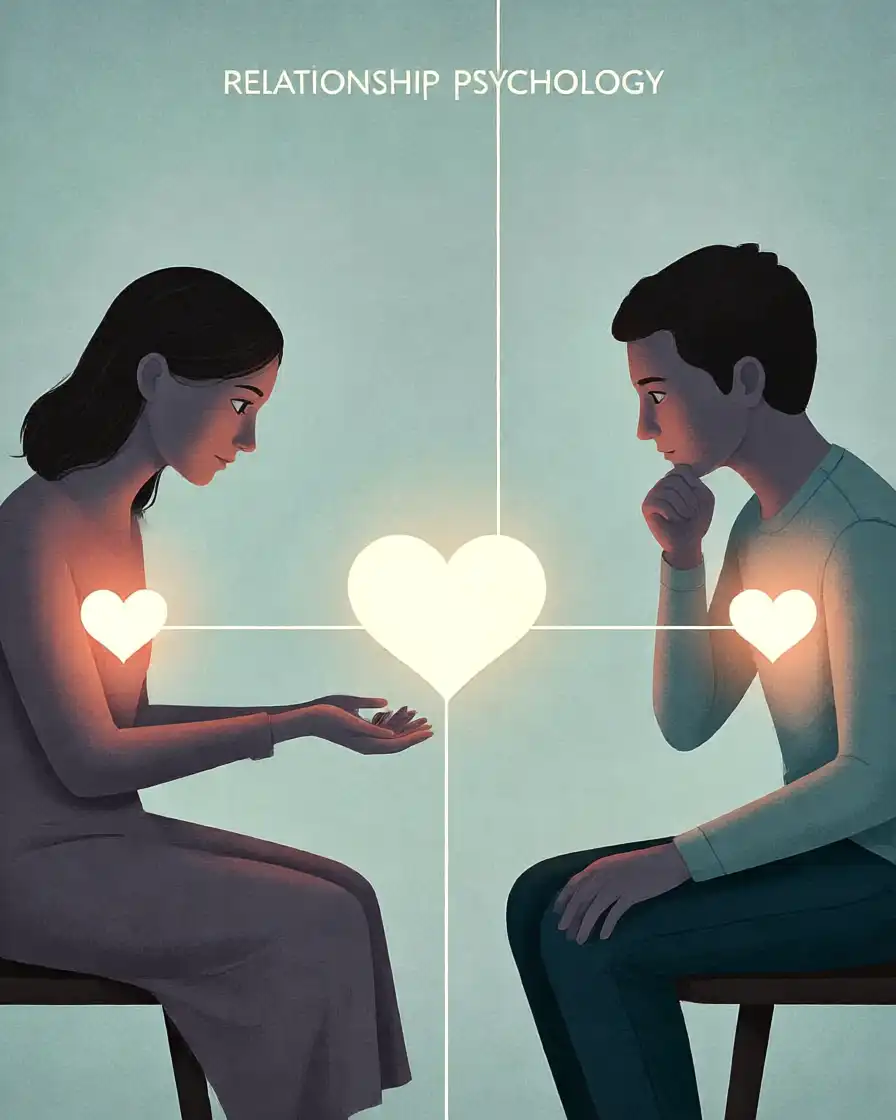
Acording to Psychology of Relationship When you’re in love, you never act at random. (This page is dedicated to understand the psychology of relationship) Your inner psychology is the source of every response, silence, and emotional habit. We can better understand why we feel emotionally detached from certain people and intensely attached to others by studying the psychology of relationship . Your communication, conflict resolution, and desire for intimacy are frequently influenced by your emotional needs, attachment types, and past experiences.
Many people think that love is solely motivated by emotions, however research reveals otherwise. Attraction, trust, and commitment are shaped by unconscious patterns , it’s often related to our unconscious mind. When people are afraid of losing something, some people grow more clingy. Some retreat in order to shield themselves from emotional distress. Relationship results are subtly influenced by these actions. You can detect your own patterns by learning about psychology of relationship. This awareness enables you to forge stronger, long-lasting emotional connections in relationship. This awareness prevent repeating mistakes, and form healthier partnerships.
What Is Psychology of Relationship?
psychology of relationship is simply about understanding how people connect with each other in a relationship.It explain our behaviour in our personal life ,love life and career life .It also explain why we fail in love , quarrel with eachother. And why some relationship feel safe while others exhausting . With knowledge of this topic we can understand ourselves better. In short we will know
1.why behaviour matters more than words ?
2.how psychology shapes love pattern ?
3.how people tend to behave in relationship because of previous behaviour ?
It also looks at our emotions, thoughts,habits,and past experiences that shape how we act in relationships . It also tells us why are we unsatisfied in life.
why should we know about relationship psychology
Most of us are suffering because of unfulfilling relationship . There are hardly people who are not affected by toxic relationship, quarrel, hateful mistakes and burnout in relationship. Wheather it belongs to parent children, love relationship or career relationship. If as a society we are aware of this topics then many silly quarrel, will be avoided . It will also help many family’s to avoid the road of seperation. At its heart , the study of psychology of relationship reminds us that love isn’t just about feeling it’s about understanding effort and emotonal awareness. Psychology of relationship helps you understand :-
1) communicate better in real life relationship
2) avoid repetating toxic patterns
3) Avoid repetating Toxic people
4)let you feel more secure and confident in love
5) build healthier, happier, relationship
Relationship Psychology Facts You Should Know
Facts from the knowledge of relationship psychology shows us that actions speak louder than words. Relationship outcomes are better predicted by acts than by promises, according to research from relationship studies. Attraction comes after familiarity, which is a crucial truth in relationship. It also helps you understand the psychology of love.
Example of Jhon Bowlby’s study in everyday relationship
According to attachment studies by psychologist John Bowlby, people are attracted to emotional patterns they were taught at a young age.
A person who received inconsistent care, for instance, can be drawn to partners who are emotionally unavailable. The pattern is unhealthy and seems familiar. It indirectly tells our need which we are probably not familiar enough.Emotional safety is more vital than passion, which is another crucial aspect. Couples who feel emotionally safe exhibit higher levels of relationship satisfaction, according to a long-term study conducted by the Gottman Institute. Couples that engaged in validation practices reported less arguments within months.
Truth about couple fighting
Other facts in the study of psychology of relationship also show that conflict is not the true issue. According to research, the manner in which couples quarrel is more important than the frequency of their arguments. Meaning if a word of rejection can be said gentle it may have different results.Couples who avoid confrontation frequently report less intimacy than couples who respectfully but openly disagree, according to clinical observations. Love is largely influenced by unconscious behavior. Emotional responses precede rational thought . It can cause couple fighting or seperation. Couple fighting for prolong time period can also cause burnout in relationship.
There are people who reported having trouble in their arrange marriage. Relationship therapy case studies demonstrate how stress triggers outdated coping mechanisms. Someone may become clingy if they are afraid of being abandoned. A person who is afraid of intimacy may become emotionally distant.
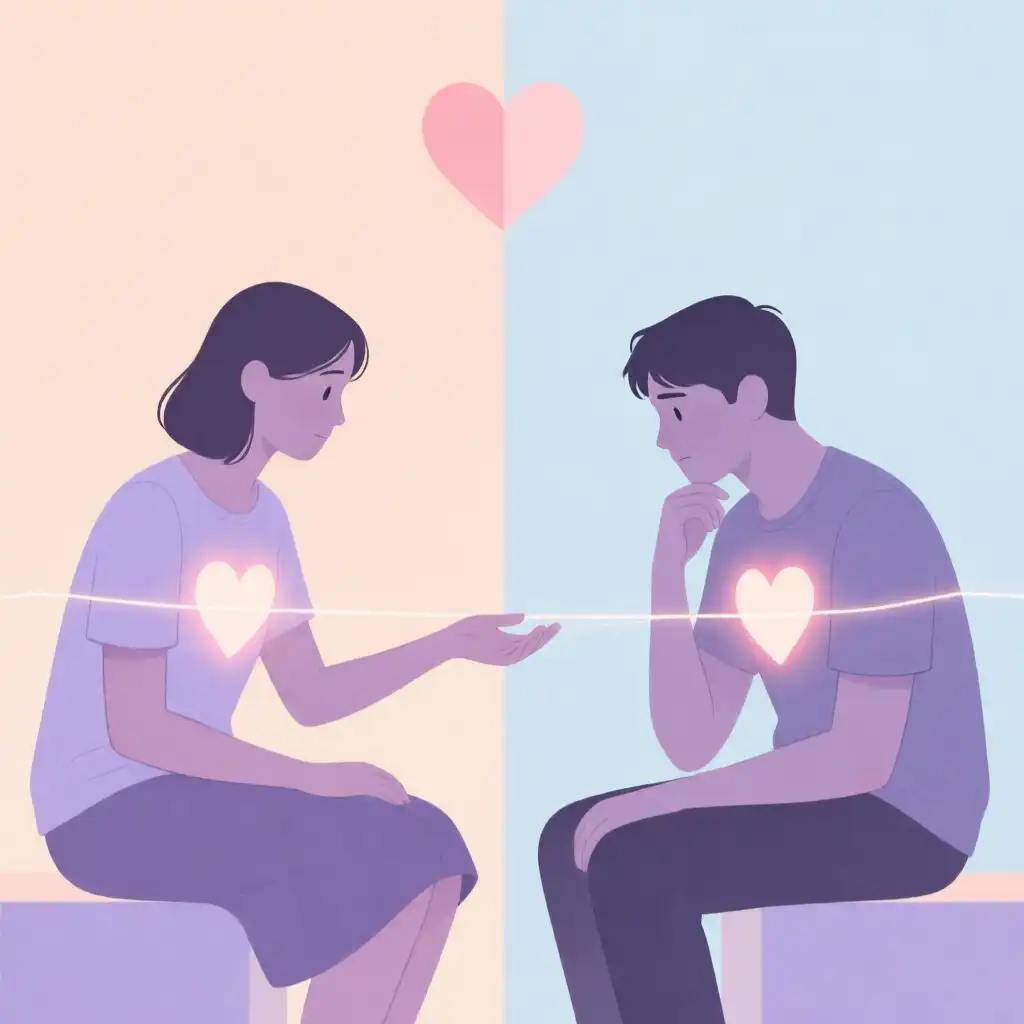
How Behavior in Relationships Reveals Emotional Needs
Relationship behavior frequently speaks louder than words. Little deeds show a person’s emotional requirements. Distance, intimacy, quiet, or excessive communication are not arbitrary. So some folks want assurance all the time. They respond quickly. When messages slow down, they become concerned. This conduct frequently indicates a need for emotional stability. One such scenario is when plans change and a partner is nervous. Control is not the true need. It’s comforting. When there is confrontation, others withdraw. They remain silent. They steer clear of sensitive discussions.So the demand for safety is typically reflected in this behavior. Many avoidant partners in marital counseling express a concern of experiencing too much emotion. They start using distance as a means of self-control.
Another powerful indication is people-pleasing. Even when they’re worn out, some couples say yes. They steer clear of conflict. According to case studies, this behavior frequently results from a desire for acceptability. More than discomfort, they fear rejection. Emotional demands are also concealed by anger. Hurt or insecurity are frequently concealed by sudden annoyance or defensiveness. For instance, a spouse might respond negatively to criticism. Respect or validation is the true need beneath. Everything is altered when conduct is understood. Pause and observe instead of responding. Find out what the behavior is safeguarding. Find out what emotional demand isn’t being satisfied.
Healthy relationships grow when needs are expressed clearly.Clinginess needs reassurance.Withdrawal needs patience.People-pleasing needs boundaries.Anger needs empathy.When you respond to the need instead of the behavior, connection improves.This shift reduces conflict.It builds trust.Most importantly, it creates emotional safety for both partners.
Unconscious Behavior During Relationship Fights
The majority of reactions during arguments in a relationship are unconscious. They are not selected by people. Before the mind can comprehend, the body responds. A few people speak up. They cut you off. They talk quickly. Fear of not being heard is a common cause of this behavior. These couples frequently discovered early on in therapy that soothing sounds were disregarded. It seems protective to fight louder. Some shut down entirely. They stop talking. They don’t make eye contact. This is not a sign of apathy. It’s a reaction to stress. Their neurological system enters a state of freezing. They feel safer when there is silence.
Another unconscious response is defensiveness. A straightforward grievance seems like an assault. For instance, when a spouse hears, “You forgot to call,” their body interprets it as “You are not good enough.” Instant rationalization or shifting of blame is the response. Some people bring up past problems. They stack errors from the past. Unresolved emotional distress is indicated by this behavior. To defend itself, the brain looks for proof. It’s also unconscious to cry during a battle. It’s not manipulation. It is an outpouring of emotions. Tears are the nervous system’s way of releasing tension. Damage is decreased by being aware of these tendencies. Take a moment before responding. Take slow breaths. Instead of criticizing the individual, identify the emotion. Instead of making accusations, say, “I feel overwhelmed.” Rather than shutting down, say, “I need a break.” Fights become safer when partners are aware of unconscious conduct.
Psychology of relationship theories That Explain Love Behavior
Relationship psychology theory explains why people behave in certain ways when it comes to love, conflict, and reactions. Behavior, emotions, and attachment are the main topics of these theories. Attachment theory is one fundamental hypothesis. John Bowlby was the one who created it. It clarifies how early bonding influences relationships in adulthood. Closeness is safe for those who have a secure attachment. They are clear in communicating their needs. Fear of abandonment is a result of anxious attachment. These partners want confidence. Fear of reliance is a result of avoidant attachment. When there is disagreement, these partners distance themselves.
Social exchange theory is another significant idea in relationship psychology. According to this hypothesis, people assess relationships based on the emotional cost and return without realizing it. Resentment increases when effort is perceived as unequal. For instance, one partner can feel exhausted while the other is content. When silent ends conflict, silence becomes a habit.
Anger repeats itself if it attracts attention. Behavior is acquired by results. Emotional responses under stress are explained by the notion of emotion regulation. Some people find it easy to relax. Others experience overwhelm. Couples’ approaches to conflict are impacted by this distinction. Lastly, relationship beliefs are explained by cognitive theory. Behavior is shaped by ideas such as “I am unlovable” or “People always leave.” These ideas frequently function subconsciously. Love is not random, according to relationship psychology theory. One learns patterns. Additionally, with consciousness and effort, learned patterns can be altered.
Attachment Styles Often Seen in Toxic Relationships
Insecure attachment styles are the root cause of some relationship behaviors. Over time, these tendencies lead to emotional tension. Anxious attachments are characterized by a fear of disconnection. They frequently look for confidence concerned with little adjustments, overconsider tone or messages. Rather than a desire for control, this conduct stems from a strong need for safety. Avoidant attachment is characterized by a fear of emotional intimacy. They place a high importance on independence. When there is conflict, they retreat. They find it difficult to communicate their emotions. They feel safer when they are far away.
Love Behavior acording to Psychology of relationship
Emotional requirements are revealed through love behavior. Words are not as powerful as deeds. Patterns are the focus of contemporary psychology. It watches how people text , monitors responses to conflict, examines feelings. Some folks seek intimacy. Others keep their distance. They both want to be protected. One aspect of love behavior is consistency. Empathy is a part of it. Boundaries are included. Calm is a sign of healthy love. It seems encouraging. It seems foreseeable. Love that is unhealthy feels powerful. It seems shaky. It makes people anxious. Early attraction is driven by dopamine. Later, bonding is strengthened by oxytocin. Long-term stability is determined by attachment. Intensity and love are frequently confused. It feels thrilling to be intense. For many, stability is alien.
Modern research shows this clearly.Secure love grows slowly.It feels peaceful, not chaotic.Understanding love behavior prevents self-blame.It shifts focus from fantasy to reality.It helps choose healthier partners.
Repeating Relationship Patterns
The same romantic narrative is often repeated. distinct faces. The same discomfort. Unconsciously, patterns emerge. The brain looks for familiarity. Even unhealthy familiarity has a sense of security. A person who was raised inconsistently might look for it once more. Ignored people might pursue unavailable relationships. A dominating person may draw controlling others to them. There is a magnetic quality to these patterns. They have a strong feeling. They believe they were “meant to be.” However, compatibility does not equate to intensity. Repetition is an indication of unhealed wounds. This repetition is referred to as compulsion in psychology. The mind attempts to change the past. It aspires to a different conclusion.
The cycle is broken by awareness. When patterns are plainly visible, their strength diminishes. Make straightforward inquiries. What makes this seem familiar? Why does this seem so urgent? New decisions are made as a result of healing. At first, healthy love could seem dull. However, boredom frequently equates to safety. Noticing is the first step toward change. Conscious action follows. Then the true change starts.
What Your Behavior Reveals
Inner beliefs are revealed through behavior. It displays the emotional past. It matters how you respond to conflict. Do you shut down? Are you an attacker? Do you stay away? Attachment is revealed by texting habits. Quick responses could be an indication of worry. Responses that are delayed could indicate avoidance. Self-worth is revealed through boundaries. Weak boundaries lead to animosity. Respect is produced by strong boundaries. Fear is revealed by jealousy. Emotional overload is revealed by silence. Fear of losing is revealed by overgiving. People frequently make moral judgments on behavior. Psychology takes a sympathetic stance. You were previously protected by every action. Choice comes from self-awareness. Rather than reacting, you can react. Look for trends without feeling guilty. Criticism takes longer to heal than curiosity. Relationships alter when behavior does. Internal growth is the first step. The outcomes show up outwardly.
Changing Unhealthy Behavior
Awareness is the first step toward change. What you deny cannot be fixed. Give the pattern a clear name. Steer clear of ambiguous terminology. Be truthful with yourself. Take a moment before responding. Regulation of the nervous system is important. Emotional impulses are slowed by breathing. Substitute response for reaction. Big changes are produced by little pauses. Every day, engage in safe behaviors. Calmly express your needs. Maintain constant respect for boundaries. Be prepared for discomfort. Growth is strange. The brain is resistant to change. Habits are rewired by consistency. Not flawless. Progress is more important. Healing is aided by support. Understanding is accelerated by therapy. Clarity is increased by journaling. You used to be safe when you engaged in unhealthy conduct. I’m grateful. After then, let it go. It is conceivable for things to change. Psychology demonstrates this. Love is healthier when it is self-worked.
FAQS
Can attachment style change?
Yes, attachment style may change in a relationship with consistent efforts and understanding.for example In our life it shows if a child is neglected From a young age then they can attract dominaring and manipulate partner in life . But the relationship can change with consistent efforts
Why do healthy relationships feel boring?
Its not actually healthy relationships that felt boring for some people. It’s their inner child who craves more attention from its partners . Sometime our brain predict healthy relationships as no feelings from partner.
How long does behavior change take?
It depends on people. For some people it may take one year but for some it can take one lifetime.some time the use of power of scilence can also cause significant changes in your relationship.
Conclusion
Relationship conduct is not arbitrary. It adheres to psychological trends. Love is shaped by attachment style. Emotional requirements are revealed through behavior. Unconsciously, patterns recur. Knowing who you are transforms everything. It turns guilt into understanding. It transforms suffering into development. So a healthy relationship feels secure. It is serene. It seems reliable. Change begins on the inside. The first step is self-awareness. Healing comes easily. Psychology provides resources. You bring dedication. When combined, they change relationships.
2 thoughts on “Psychology of Relationship in 2026: why we fight with our loved one”